This is my fourth post-mortem article on making fingerboard wheels.
During the prototyping phase, the first step is to design a “male” part that will be used to make the silicone mold for the wheels (female part). This mold will then be used to pour the resin and make the wheels.
Getting your first part
Resin-cast fingerboard wheels are almost all made using the same process: resin printing. Resin printers have a precision of 0.5 to 0.01 mm, which is perfect for the size of fingerboard wheels. Some printers are more precise than others; the size of the screen and its resolution affect the precision and final quality of the parts. For my part, I went with the Creality Halot R6 because it is compact and inexpensive. The screen does not have a high resolution (2K), but since it is very small, the pixel size is small enough to allow for the printing of precise parts.
Finding the right piece size for you
With over 80 prototypes, I was able to experiment with the best way to print these microscopic pieces. It's important to note that resin printing is hazardous to health, as the fumes are carcinogenic and uncured resin is dangerous to living beings and the environment.
Therefore, cleaning the parts and workspace must be a priority, and designing your parts with this in mind can save you a lot of time!

Printing wheels individually
Printing parts individually (i.e., separately on the print plate) is one option. This is a solution I used on about twenty prototypes.

Advantages:
- Cleaning resin/alcohol off the wheels after printing is very easy.
- Allows you to see the final result of the wheel, its shape, dimensions, etc.
Disadvantages:
- Very laborious to clean, piece by piece. When printing three prototypes at a time, it is very time-consuming and therefore increases the risk of contamination.
- When you have a lot of prototypes, it is very difficult to keep track of which generation the wheels belong to because the differences are microscopic. Dropping your prototypes or mixing up the parts means you can quickly lose track of them!
Printing your wheels with a “plate” support
This is the most common method: you design a plate on which you place the wheels. When printed, the wheels are glued to the plate and do not move. Each version of the prototype is represented by a single object, rather than several scattered wheels. You can even add text to the plate to indicate which version of the prototype you are working with! Just remember to mirror the text so that it is legible on the silicone mold.

Advantages:
- Only one part per prototype, no risk of mixing up the wheels
- Easy to handle, and therefore easy to clean
- Easy to set up for casting the silicone mold, no risk of a wheel moving during casting.
Disadvantages:
- If the wheels have a bevel on the back, it can sometimes be difficult to clean the area between the wheel and the plate properly.
The ideal mold format
Wheel making is not easy, and prototypes will multiply. So having a mold format that is easy to manufacture is important.
When pouring silicone around the male parts, a container is needed. Traditionally, silicone containers are made of wood or plastic and fastened with bolts, nails, or screws. This method works but is laborious and time-consuming to set up and use on a daily basis.
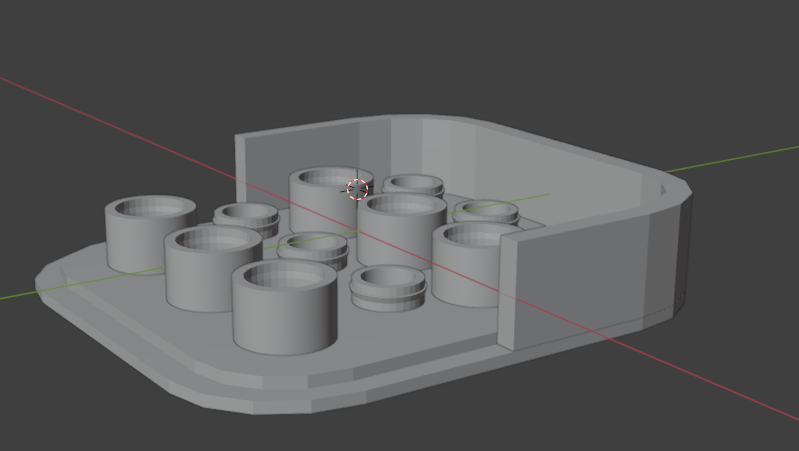
One solution is to create a 3D-printed container that can easily accommodate the male part(s). In my case, my container consisted of two 3D-printed walls, which I held together with a rubber band. The male part plate serves as the “bottom” surface, which has a rim that allows the walls to be placed on top and prevents them from moving during casting.