This article aims to answer a few questions about the different methods used to press fingerboard decks. And if possible, save some time for future (or current) deck makers who might read this article.
What force is needed to press fingerboard decks?
A very common misconception in the fingerboard community is that you need to apply a large amount of pressure to the mold to obtain "professional" quality fingerboard decks.
During my research, I often read that a pressure of 2 to 3 tons was necessary. This is false—and it’s actually far too much! Based on my tests, a pressure of 0.5 to 1.5 tons is more than enough. It’s also possible to press up to 4 decks at once with only 1.5 tons (while keeping plastic molds intact).
1.5 tons isn’t that much: a hydraulic press isn’t necessarily required, since this level of pressure can be achieved with a simple vise or screw press.
Different types of presses
Using a vise
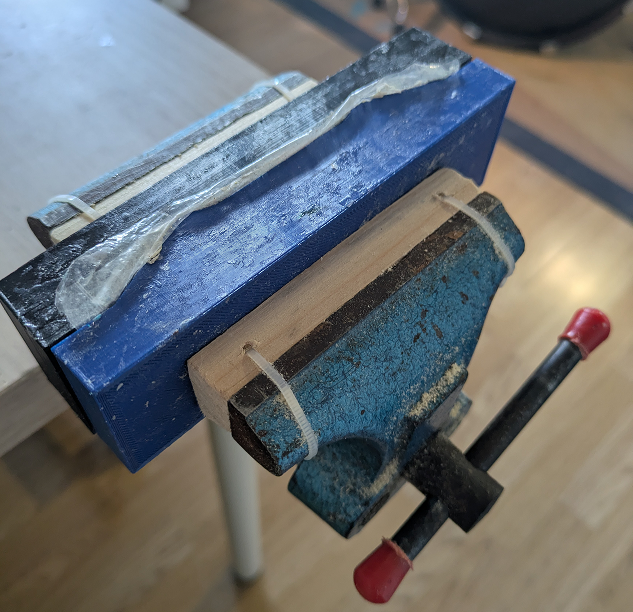
Vises are one of the easiest types of presses to find, but not the easiest to use. Because the jaws close horizontally, properly centering the mold is not easy.
The main drawback of vises is that they are often made of cast iron, and applying high pressure over a long period creates a significant risk of breakage.
Using nuts and bolts
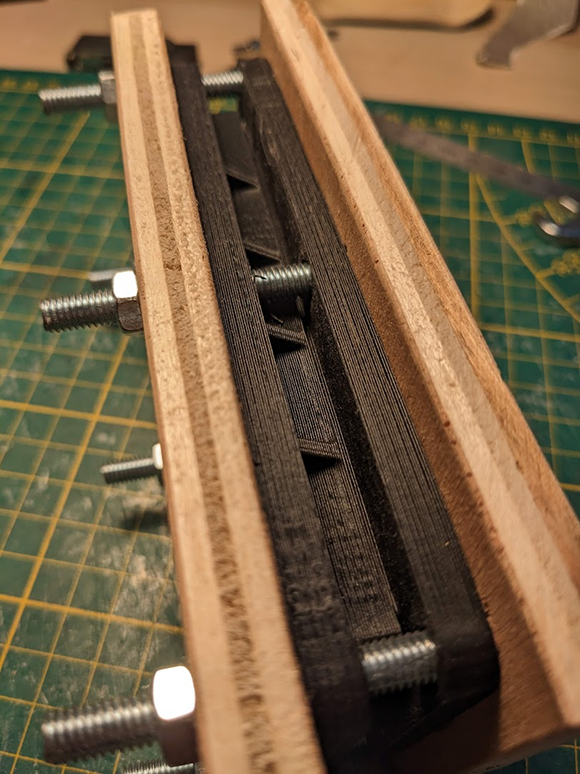
With a slightly wider mold, and holes on both the top and bottom parts of the mold, you can pass bolts through and tighten the fingerboard decks with a very high amount of force.
I used this technique for a year and never had a single issue with uneven concave. It’s an inexpensive solution, but it has a major downside: it takes a long time to set up! With 6 bolts per mold, tightening each nut takes time. For occasional use, it’s acceptable, but for “professional” use, it becomes extremely time-consuming—especially when pressing multiple decks at once.
Using a hydraulic press
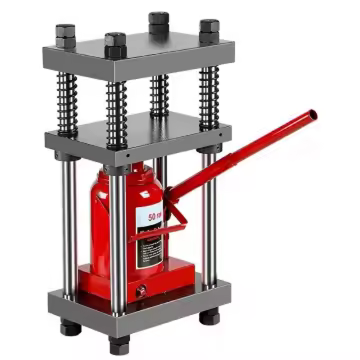
The holy grail of fingerboard pressing, seen everywhere: the hydraulic press has only one drawback—the space it takes up. Since my workshop is very small, I can’t afford to have a hydraulic press and have therefore never owned one. However, it’s possible to build a very simple and inexpensive press if you’re a bit handy, using a jack.
Hydraulic presses are truly the best way to press these decks. Controlled pressure in both amount and duration—there’s nothing better (a 1 to 2 ton press is sufficient!).
Using... a book press?
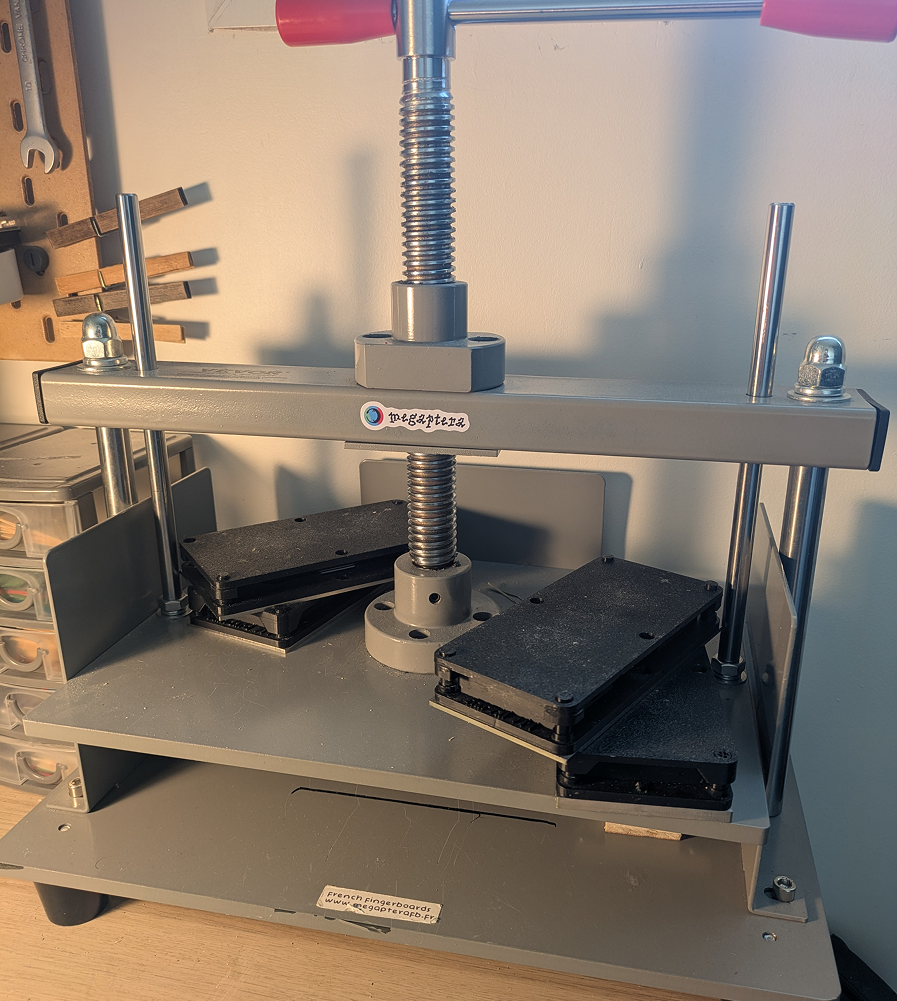
A book press is used to bind books—nothing to do with fingerboarding—but surprisingly, it’s not a bad option! Since I couldn’t fit a hydraulic press into my workshop, I opted for a book press instead. I have to say that, compared to the nuts-and-bolts method, it’s night and day.
As long as the molds are properly centered under the tightening screw, I’m able to press up to 4 decks at once without any concave deformation. It’s an inexpensive solution (around €65 at the time of writing, the VEVOR Book Press) and takes up very little space.
Other presses
I’ve tested other types of presses without much success: vertical jewelry press, woodworking vise, etc. The issue with these presses is that the clamping pressure is off-center, and the main risk is uneven concave from one side to the other. Therefore, I can’t recommend them.